Here are 10 basic rules when negotiating compensation, the “Ten Commandments of Employment Negotiations,” to help you get the best possible deal when changing jobs, whether internally or with a new company excerpted from Get More Money On Your Next Job. They are:
1. Be prepared. The more you know about the job market and about your prospective employer, the better you will negotiate. Information is readily available on the Internet, at the library, from professional associations and through networking. Time spent learning how to negotiate is time well spent and will pay dividends throughout your career. Proper preparation enables you to know what is possible and to get what you want. This is the first commandment because it's the most important thing you do as a negotiator.
2. Recognize that employment negotiations are unique. While you want to negotiate the best possible deal, you need to do so in a way that doesn't damage your relationship with your future employer. At the same time, the employer's primary concern isn't negotiating the least expensive compensation package it can get away with. Keep in mind that your future employer wants you to accept the position and feel good about doing so. Remember that when the negotiations are over, you'll have to work with the person with whom you are negotiating.
3. Understand your needs and those of your prospective employer. Employment negotiations are about priorities- yours and the employer’s. What is important to you? Are you to accept a low salary in return for a large equity stake? Are you able to handle dramatic swings in income from year to year? Understanding your needs will also help you select the type of company you want to work for. While a family-owned business may be unwilling to offer equity or ownership to a non-family member, may be willing to offer a large bonus based on results. A start-up company, in contrast, may not be able to offer a market-rate salary, but will typically offer stock options. By recognizing what an employer is most willing to do, you'll be able to determine what trade offs are possible to maximize what you get.
4. Understand the dynamics of the particular negotiations. Sometimes you'll have skills that are in great demand. At other times, you may be one of many qualified candidates each of whom the company would be happy to hire. Sizing up the situation and understanding the relative bargaining position of each party will help you determine when to press your advantage and when to back off.
5. Never lie, but use the truth to your advantage. It is not only wrong to lie, but in employment negotiations, it's ineffective. If you lie during negotiations, sooner or later you are likely to get caught. Then, even if the employer doesn’t withdraw the offer, you'll be at a tremendous disadvantage, and your credibility will be forever damaged. On the other hand, total candor won't be rewarded. You're under no obligation to blurt out everything you know. You can determine what you want to say and how you want to say it, placing everything in its most favorable light. One key aspect of your preparation is recognizing potential problems so you can determine, ahead of time, how you will handle them when they inevitably come up.
6. Understand the role fairness plays in the process. Appeals to fairness can be an extremely powerful weapon. The guiding principle for most employers when they negotiate is fairness. Within the constraints of their budget and organizational structure, employers usually will agree to anything that's fair and reasonable. So be able to justify every request you make in terms of fairness. Understanding the role that fairness plays in employment negotiations can mean the difference between success and failure.
7. Use uncertainty to your advantage. The more information you convey to a potential employer about your bottom line, the more likely it will limit what you get. Employers typically ask what it will take for you to accept the position, before they make you an offer. With that information, a prospective employer can determine the minimum package it needs to offer. While an employer may not offer you as little as it can get away with, divulging too much information will likely result in a lower offer. By not disclosing your exact compensation or what it would take to get you to accept the position, you force a potential employer to make its best offer. When dealing with a recruiter, however, you may need to provide more detailed salary information. If you do, though, present that information in the most advantageous way.
8. Be creative. Consider the value of the total package. Look for different ways to achieve your goals. Be willing to make tradeoffs that increase the total value of the deal. By being creative, you can package what you want in ways that will be acceptable to the company. You'll also be able to find creative "trades" that allow you to withdraw requests that might be problematic to the company in return for improvements in areas where the company has more flexibility.
9. Focus on your goals, not on winning. Too often in negotiations, winning becomes more important than achieving your goals. It's important not to make your future boss feel as if he's lost in the negotiations. You'll have gained little by negotiating a good deal if you alienate your future boss in the process.
10. Know when to quit bargaining. The one sure way to lose everything you've gained through your negotiating efforts is to be greedy. There comes a point in every negotiation when you've achieved everything you could have reasonably expected to achieve. While most companies will want to treat you fairly and make you happy, few companies want to hire a prima donna. Being perceived as greedy or unreasonable may cause the deal to fall apart. Even if it doesn't, you'll have done immeasurable harm to your career.
This brings us to the Eleventh commandment:
11. Never forget that employment is an ongoing relationship. Job negotiations are the starting point for your career with a company. Get too little and you're disadvantaged throughout your career there; push too hard and you can sour the relationship before it begins.
Understanding these principles will allow you to effectively negotiate the terms of your new job in good times and in bad. Once you are hired, do a good job and continually seek out new challenges. As you take on added responsibilities and learn new skills, there will be opportunities to negotiate further improvements.
Latest Book
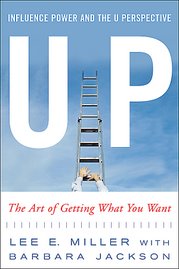
UP: Influence Power and the U Perspective-- The Art of Getting What You Want
Sunday, September 16, 2007


Tuesday, September 4, 2007
Motivating People Is About Recognizing What They Care About

Looking for a promotion? Need help from your colleagues? Want you boss to give you additional resources for that project you are working on? You have to start by asking, but understanding how to ask will make all the difference between getting what you want and going away empty handed. How you should ask depends on what motivates the person you are asking- what I refer to as their "U Perspective" in my most recent book UP: Influence Power and othe U Perspective-The Art of Getting What You Want .
Most people simply assume that everyone is motivated in the same way that they are. Even when we recognize that someone else might see a situation differently than we do, our first instinct usually is to try to persuade them to see things our way. The U Perspective takes the opposite approach. Its effectiveness is not rooted in the ability to convince others to change their views or adopt different values. Instead, its power comes from recognizing what others already believe and want and motivating them to help you achieve your objectives based on that information. The U Perspective allows you to get what you want by working with another person’s belief system, not challenging it. To achieve this level of understanding, you need to discover how the person you are trying to influence perceives a situation and what is important to him or her -- to learn to see things through their eyes. Once you understand how they see a situation you have the ability to construct, and present options in a way that more effectively influences what they do.
We think money will motivate people to do just about anything. While that may true it takes an awful lot of money to get people to do certain things and there are some things that even a lot of money may not get certain individuals to do. More importantly, sometimes money is not the best motivator.
Computer scientists have used an understanding of what certain web users value to literally get them to do work that no one else wants to do and to do it for free. Impossible. Not if you understand the concept of the U Perspective. One of the most boring tasks I can think of is labeling images to enable online searching. This is a task computers can not yet do; so it requires viewers to look at the images and assign them key words that identify them. How much would you expect to be paid to do that work? Louis Van Ahn, a professor at Carnegie MellonUniversity, has figured out how to get people to do it for free. He simply turned it into a game. The game connects random players who log in to the website. Each is shown the same picture for which they type in keywords. When the words match they are awarded points. People return to the website frequently and have been known to play for hours.
When it comes to getting a new job, a promotion or a raise, understanding what the decision-maker cares about is critical to success. If you show how what you are asking for will further some goal they care about, you will likely get what you want. If you can help your boss or prospective boss look good or accomplish an important objective you are likely to win the new job, promotion or raise that you are seeking.
Tuesday, August 28, 2007
Interviewing Do's and Don't
 A recent survey showed that almost half the people working today are considering leaving their jobs. The difference between success and failure when it comes to getting a new job is your ability to interview. The more effective you are when you interview the better your chances of getting the job you want. So here are some Dos and Don'ts for interviewing:
 INTERVIEWING DOs
1) Prepare: Find out everything you can about the company, the job and the interviewer.
2) Focus on accomplishments not responsibilities.
3) Ask knowledgeable questions.
4) Make friends with the secretaries and assistants involved in the hiring process.
5) Be enthusiastic.
6) Always be positive.
7) Ask for the job.
INTERVIEWING DONTs
1) Don't ever say anything bad about a prior employer, even if true.
2) Avoid being too deferential to the interviewer.
3) Don’t interrupt the interviewer.
4) Avoid talking about salary, or talk about it as little as possible, until you get an offer.
5) Do not assume you can’t negotiate a better deal. (You can if you know how and when to do so)
For more information go to YourCareerDoctors.com
1) Prepare: Find out everything you can about the company, the job and the interviewer.
2) Focus on accomplishments not responsibilities.
3) Ask knowledgeable questions.
4) Make friends with the secretaries and assistants involved in the hiring process.
5) Be enthusiastic.
6) Always be positive.
7) Ask for the job.
INTERVIEWING DONTs
1) Don't ever say anything bad about a prior employer, even if true.
2) Avoid being too deferential to the interviewer.
3) Don’t interrupt the interviewer.
4) Avoid talking about salary, or talk about it as little as possible, until you get an offer.
5) Do not assume you can’t negotiate a better deal. (You can if you know how and when to do so)
For more information go to YourCareerDoctors.com
Monday, August 27, 2007
Fall: A time to Focus on Your Career

People are returning from their vacations. Kids are returning to school. You should be focusing on your career. With the end of the summer upon us, now is a good time to focus on your career. Are you looking for a promotion, that raise you deserve or greater job satisfaction? Here are three tips to start the season off right:
1. Try a new look- one that is designed to project authority
2 Nurture your network
3. Take on a project designed to increase your visibility
Try A New Look: How a person looks and how they carry themselves forms the foundation of how people view them. Creating the right image will enhance one’s ability to persuade others. That requires you to look the way the people you are dealing with expect someone in authority to look. So dress like the people who are in the position you aspire to. Police Officers, judges, and doctors for example, all dress in a way that let’s you know instantly that they are functioning in a role that sets them apart from the rest of us and signals how we are expected to react to their directives. Different occupations have different ways of dressing to indicate your status. That will of course be different for women than for men. It will also differ depending on whether you are in Singapore, New York or Moscow. Look at how successful individuals in your field dress and let that guide you.
Nurture Your Network: Create a network of people who care about your career success. How do you do that? Build relationships with people in your field, both within your organization and outside. Stay in touch. Periodically call them and try to get together. E-mail them with information that they might find useful. Send them articles of interest. Remember their birthdays. Ask for their help and advise. More importantly, offer assistance. Look for ways tohelp them. Networking is about giving. give unselfishly. Your efforts will pay dividends many times over.
Take On a Project Designed to Increase Your Visibility: Seek out opportunities to work on projects that are important to the organization and to your boss. Good work is not enough. Your work needs to be noticed. So try to do it where people are looking. Work on the projects that people care about. do a good job and people will take note. I have a saying I use when I coach " If a tree fall in the forest and no one hears, who cares? But if you do great work and no one notices then career opportunities pass you by.
Coming into the Fall with a plan to move your career forward and you will reap the benefits. For more information go to YourCareerDoctors.com
Monday, August 20, 2007
Career Change Can Be Very Rewarding
 I am in the Berkshires at a golf resort with a friend, and client, who publishes a golf and resort guides. He started his career as a lawyer and had developed a successful practice. A friend of his needed a favor. She was the editor of a monthly regional lifestyle magazine. They were doing a special edition with a section that covered all the major golf courses in the region. Their writer had just pulled out. My friend was a good golfer, a good writer and had previously helped another friend, a professional golfer, write a golf book. She asked him if he would take a little time off, come down and write the section for her. She, of course, offered to pay him.
He called me for advice. He wanted to do it, but financially it did not make any sense for him. While he wasn't really happy with the work he was doing, it certainly paid much better then working as a freelance writer. He was thinking about doing it anyway, as a favor to his friend and because it sounded like fun. We talked about it for a while. Then I suggested a way that he could write the piece and make money. Since we were dealing with a magazine that was not in the guide business I knew that they only intended to use what he wrote one time, when the monthly magazine was published. So I suggested he sell the magazine the right to first publication and exclusive rights thereafter for 90 days. Then the rights to what he wrote would revert to him. Since that was all the magazine was going to use the material for anyway and because they were in a bit of a bind, they readily agreed. After the 90 days he republished the material, along with a map of the courses, some additional photo spreads and some articles about other attractions in the region as a golf guide. He was able to get advertisers to run ads in the guide and the golf courses and resorts to purchase reprints. In that way he was able to make a nice profit.
The story does not end there. He was so successful, and enjoyed it so much, that he gave up the work he was doing and began to publish golf and resort guides internationally, using that same formula. He now travels all over the world, stays in fabulous resorts and has published guides in such exotic places as Thailand and the Dominican Republic. What started as a lark became a fulfilling and financially rewarding second career for my friend.
Everything started with a single project that he did for two weeks while on vacation from his regular job. If you do not find fulfillment in what you are doing, you don't have to quit your job. Start small. See if you can turn a hobby into a second career. Moonlight. Try things out on weekends and when you have vacation time. You never know where it will take you.
Saturday, August 18, 2007
When is a $70 million dollar salary not enough?
 When your friends are making $71 million dollars. I was surprised to read in the Wall Street Journal that Mark McGoldrick left a prestigious position at Goldman Sachs running their " Special Situations Group" because he felt that he was working too hard and wasn't being paid enough. The salary he was not happy with, last year amounted to $70 million dollar ($200,000 a day). Most of us won't make $70 million dollar in our lifetime and would be thrilled with a hundredth of that salary. So what makes someone complain about a salary bigger than the gross national product of certain small countries? Fairness, jealousy, envy. Call it what you will but in life we measure happiness not by what we have in some absolute sense, but rather by what we have compared to the people we feel are like us.
So Mark McGoldrick was unhappy with his salary because his counterparts at hedge funds and private equity firms were making a lot more than he was. This should not have come as a surprise to me.
As I wrote in UP: Influence Power and the U Perspective-- The Art of Getting What You Want:" While money can effectively be used as a motivator, even money becomes significantly less useful as a motivator once you achieve a certain level of wealth. There is a significant body of research that shows that once personal wealth reaches a certain level additional wealth produces virtually no increase in one’s sense of happiness. Moreover, according to Richard Layard, a professor at the London School of Economics, peoples’ sense of their own wealth is subjective and is determined primarily by comparing themselves to others. Therefore when incomes rise across a nation there is no greater sense of wealth or happiness. For example, real income in Japan more than quintupled over the thirty years starting in the1950s yet researchers found no corresponding increase in how happy people felt. Even very wealthy people can feel disadvantaged when their friends are significantly wealthier than they are. Understanding that may cause you to propose a business opportunity to a very wealthy individual by focusing on some other benefit beyond just its profitability, such as by making it exclusively available to that individual or by allowing that individual to gain status by being able to offer it to his or her friends."
Understanding that we react in this way and that so do others is important to keep in mind if you are seeking to get hired, to get a raise or to gain a promotion. The fact that someone else is interested in hiring you makes you more valuable. It is not so much the fear of losing you that increases your value. Trust me, they will find someone else equally talented. It is losing you to someone else, especially someone they view as a competitor, that really drives people crazy. We all want what other's want and it is even better if we are the only one, or one of an elite few, that has it. Harness that knowledge to your advantage to move your career forward.
Wednesday, August 15, 2007
Stress and the Pace of Working in the US
I am two days back in the USA. People in Singapore and India work very hard. Some do so and are just barely able to scratch out a living. Nonetheless it is not the same. We really do move at a much faster pace than anywhere else in the world. We just take for granted that we are on call 24/7 with our cell phones, blackberrys, Internet, video cams etc. No where else is anyone so connected to their work. To the extent that you enjoy your work it provides a source of satisfaction. But sometimes you have to disconnect. When I was traveling I left a message on my voicemail that I would not be checking it and to contact me by e-mail. I was able to conduct my business but the pace somehow seemed less hectic.
That brings home the point of how important it is to take some time off periodically to refresh yourself. When I was a corporate executive I got to travel to lots of exotic places but I never got to really see them. I saw the hotels. I ate at nice restaurants. I went to lots of restaurants and bars. Then I went home. What a waste.
Take your vacation time. Most Americans don't use all their vacation. They are too busy and it is too hard to catch up when they get back. Or they are afraid if they are gone that they will miss something important. Hard work is important to success but you need to stop every once and a while to see what is going on around you and around the world, not to mention sharing time with the people you care about. It will make you better at what you do and a better person as well.
That brings home the point of how important it is to take some time off periodically to refresh yourself. When I was a corporate executive I got to travel to lots of exotic places but I never got to really see them. I saw the hotels. I ate at nice restaurants. I went to lots of restaurants and bars. Then I went home. What a waste.
Take your vacation time. Most Americans don't use all their vacation. They are too busy and it is too hard to catch up when they get back. Or they are afraid if they are gone that they will miss something important. Hard work is important to success but you need to stop every once and a while to see what is going on around you and around the world, not to mention sharing time with the people you care about. It will make you better at what you do and a better person as well.
Subscribe to:
Posts (Atom)
